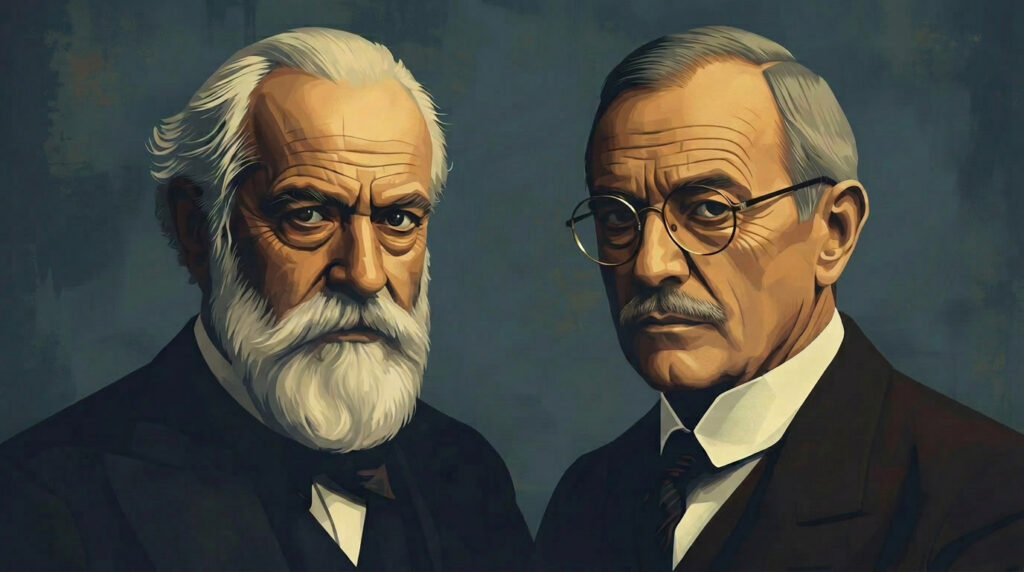
Carl Jung and Sigmund Freud had two very different views on dreams. Dreams to Freud were wish fulfilments. Jung’s view was more expansive. He didn’t lump dreams into one set category. To Jung dreams were alchemical catalysts, messages from the unconscious, and something that re-establishes psychic equilibrium. From the Jungian perspective you can think of dreams as parables.
But Jung had a tough time debunking the idea of dreams as wish fulfilments. I dare say this idea irritated him. He reiterates his opposition in many of his writings. I always thought Jung was the superior analyst, so I wondered why he spent so much time attempting to debunk Freud’s dogmatic theories.
But then it occurred to me that Jung saw something problematic when it came to this idea. It’s simply this: The way that we view our dreams changes our relationship to them. Our attitude can either be dismissive or it can be one of reverence. If dreams are mere wish fulfilments then why bother paying close attention to them? On the other hand, if dreams are messages from the unconscious, highly tailored to our circumstances and psychology, then we might view them as alchemical catalysts that can transform our lives.
Freud interprets one of his own dreams
In Chapter 3 of The Interpretation of Dreams, Freud discusses dreams as wish fulfilments. This is followed by a discussion of distortions in dreams in Chapter 4. If you believe that dreams are wish fulfilments, well then you also need to explain why dreams are sometimes strange, and silly, and shocking.
In Chapter 4 Freud analyses one of his own dreams to explain distortion in dreams. Here’s a summary of the dream:
Freud dreams that his friend “R” is his uncle. In reality though, he only has one uncle, Uncle Joseph. Uncle Joseph got into trouble with the law, and as Freud puts it, was severely punished for his mishap. This mishap cost Uncle Joseph dearly. That said, the consensus among the family was that Joseph was a simpleton—not an evil man.
Initially Freud doesn’t really understand why he would dream that Friend R was his uncle. He didn’t think there were many similarities between the two men. For instance, Friend R was never in trouble with the law. His worst offence was knocking down an apprentice with his bicycle. Furthermore, Freud had a great affection for Friend R—but not so much for his uncle. The only thing R and Joseph had in common was certain facial features, their beards in particular.
Here’s a quote from The Interpretation of Dreams:
“My uncle actually had such a long face—long and surrounded by a handsome blonde beard. My friend R was quite dark, but when dark-haired persons begin to grow grey, they pay for the glory of their youthful years. Their black beard undergoes an unpleasant change of colour, each hair separately; first it becomes reddish brown, then yellowish brown, and then at last definitely grey. The beard of my friend R is now in this stage, as is my own moreover, a fact which I notice with regret.”
Freud eventually comes to the conclusion that the dream is saying that Friend R is a simpleton just like Uncle Joseph. But Freud doesn’t really like this conclusion—he has a fondness for Friend R, but he also realises that he can hardly instruct his patients to face repressed truths and not expect the same of himself.
However, Freud misses the fact that his own beard is the same as Friend R’s. He doesn’t really ponder on this. I for one immediately wondered if the dream was asking Freud the question: Aren’t you acting foolishly in some regard? But Freud doesn’t ask this. He’s convinced that the dream is wish fulfilment. Because of his own dogmatic approach, he’s forced to view the dream through that lens.
Wish fulfilments don’t ask questions like, “Are you missing something here?” Or, “Are you acting wisely?” There is no space for inner reflection. I couldn’t help but wonder whether Freud was interpreting things correctly.
As it stands, if we recognise that his initial assessment was probably correct, meaning that Friend R is a simpleton, at least from the dream’s perspective, this still doesn’t really explain the dream as a wish fulfilment. This is where Freud goes completely off track in my view.
He links the dream to another colleague, Friend N, who did not receive a professorship. Neither Friend R nor Friend N received a professorship. One for criminal acts and the other for being a simpleton. But Freud is none of the above—at least according to his own assessment—therefore he might still expect a professorship. That is how Freud explains the dream as a wish fulfilment.
I thought Freud applied a bit too much mental gymnastics to get to that conclusion. It is possible for dreams to communicate in layers. Dreams are rich in symbolism, and feelings, and themes, and locations, and dream figures, and fractals. It’s not impossible for a dream to communicate multiple ideas in one scene. But dreams aren’t there to flatter us. Quite the opposite in fact. And not all dreams will fit into the category of a wish fulfilment. Jung’s perspective becomes important here. What we believe dreams to be, will determine how we engage with them.
How Jung approaches dream interpretation
Jung treated his own dreams and those of his patients with careful consideration. He always asked, “What is the dream trying to tell me?” He didn’t lump every dream into a pre-existing theory.
Here’s an example of a patient he treated. This particular man was very ambitious. As a first dream, he dreamt that he revisited his humble childhood village. In the dream the man encounters fellow schoolmates. However, he pretends not to know them. The people in the village say that he doesn’t come around often.
Jung comes to the conclusion that the patient’s dream is telling him that he should recognise how far he has come. He should slow down in his ambitious pursuits. As far as we can tell, the patient doesn’t internalise this message. A second dream ends up being more catastrophic. Here’s a summary of the second dream:
The man is in a great hurry because he’s going on a journey. He struggles to gather his bags. Eventually he gets it all together and hurries along the street. He then remembers that he has forgotten a briefcase with very important papers. He rushes back again to get the briefcase. He eventually dashes back to the train station again. Finally, when he reaches the station platform he sees the train moving away. The train is long and the track has a strange S-shape. The dreamer realises that the rear coaches will be thrown off track by the speed of the train. He tries to avoid this by shouting, but the train goes faster; the rear coaches are thrown off the rails. He awakes in terror.
Jung is very sure of the meaning of this dream. The man with all his rushing about is too ambitious. The initial dream also hinted to this. The patient, however, wasn’t convinced of Jung’s interpretation. Additionally, because of circumstances, treatment was terminated early. Jung writes the following:
“The upshot was that the fate depicted in the dream ran its course. He tried to exploit the professional openings that tempted his ambition, and ran so violently off the rails that the catastrophe was realised in real life.” (Modern Man in Search of a Soul)
Whether this was an upshot or not is debatable. But it does make the case that we should take warning dreams seriously. Also, lumping this dream into the category of wish fulfilment would have been a great mistake. It would have been impossible to analyse it for what it actually was: a warning dream.
Dreams are powerful
Dreams are powerful. They can help us grow. They can help us transform. They can help us to spot blind spots. And they can help us to understand deeper causal factors.
But dreams can only do that if we take them seriously. Dreams can only impact us if we heed their messages. Here’s a final quote from Jung: “… the symbol in the dream has more the value of a parable: it does not conceal, it teaches.”